


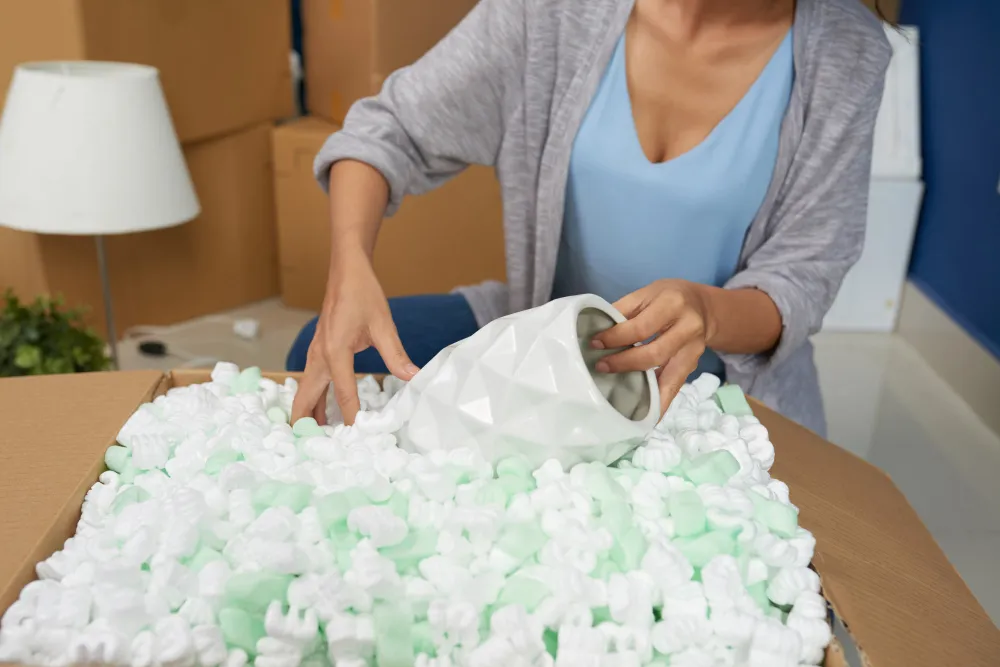
If you’re comparing foam prices in Florida, here’s the quick version. EPS (the white, bead-based foam) is usually the lowest cost per cubic foot, polyethylene (PE) costs more but protects products better, and polyurethane (PU) covers everything that needs to be soft. What you actually pay depends on the size, density, cutting and quantity of your order.
We’re IPS Foam in Clearwater, and we’ve worked with all three since 1982. Here’s what we tell customers when they ask which one to buy.
EPS foam: lowest cost for rigid jobs
EPS is the foam in coolers, shipping boxes, insulation boards, dock floats and most architectural shapes. Block-molded EPS commonly comes in densities from about 1 to 2 pounds per cubic foot, and it’s light enough that a large piece still ships easily.
Our EPS blocks, sheets and shapes are cut by hot wire or CNC router, which keeps custom shapes affordable. We also make molded EPS, insulated cooler boxes and dock floats.
The limit with EPS is that it’s rigid. It does well against crushing, but a piece that takes repeated knocks can crumble, so for products that get tossed around, look at PE instead.
Polyurethane foam: for anything that needs to be soft
PU foam is the soft, springy foam in seat cushions, pillows and upholstery. It comes in a wide range of firmness levels, and it cuts easily for inserts and padding. We carry it for furniture, marine seating, acoustic panels and packaging inserts.
Cost swings the most with PU, because a basic cushioning grade and a high-density or speciality grade are very different products. One thing to know for Florida: open-cell foam like PU has interconnected cells that absorb water, so it’s best kept dry. For damp or outdoor spots, ask us about water-resistant options.
PE and XLPE foam: protection and durability
Polyethylene foam is the tough, closed-cell material you find lining tool cases and protecting electronics, glass and finished furniture. Our own case-insert guidance notes that PE foam lasts longer than polyurethane in humid environments, which matters a lot on the Gulf Coast.
Cross-linked polyethylene (XLPE) goes a step further. It’s resistant to water, chemicals and temperature changes, though it’s harder to cut and usually needs electric saws, which is why we handle it with CNC equipment. You can see our PE, PU and XLPE sheets and custom foam case inserts online.
The three at a glance
| EPS | Polyurethane | PE / XLPE | |
| Best for | Insulation, coolers, floats, shapes | Cushions, seating, soft inserts | Protective packaging, case inserts, wet areas |
| Feel | Rigid | Soft, springy | Firm, slightly springy |
| Water | Low absorption | Absorbs water (open cell) | Resists water (closed cell) |
| Cost per cubic foot | Usually lowest | Low to high, depending on grade | Mid-range, higher for XLPE |
Use the cost row as a guide only. Grade and density change real prices, so a quote for your exact spec is the reliable number.
Florida conditions change the choice
Three things matter here that aren’t in drier states. Humidity eats at some materials, which is why PE and XLPE hold up better in damp storage. Salt air and sun matter for marine and outdoor uses, so coatings and the right closed-cell foam make a difference. And hurricane season, from June through November, can slow deliveries from out-of-state suppliers.
Buying from a Florida manufacturer shortens the trip and the lead time. We deliver across Tampa Bay and into Hillsborough, Pasco, Manatee, Sarasota and Polk counties, with delivery to many other Florida counties as well, from Orlando and Miami to Jacksonville and Tallahassee.
Cutting and fabrication change the price too.
Raw foam is only part of the cost. The way it’s shaped matters just as much:
- Rigid foam (EPS) is cut by hot wire or CNC router, and it can be moulded, coated or carved into sculpture and architectural pieces.
- Flexible foam (PE, PU, XLPE) can be die cut, water jet cut, laser cut, heat bonded, skived or sewn.
- Our team can also help with CAD design and 3D scanning if you have a part that needs a custom fit.
A simple rectangle costs far less than a cavity cut to fit a specific instrument. Sending us your part or drawing is the fastest way to find out.
What to send for a quote
Foam is quoted by specification, so the more you tell us, the faster and more accurate the price. Send:
- The foam type you want, or what the job needs to do
- Dimensions and how exact they must be (tolerance)
- Quantity, and whether it’s a one-time or repeat order
- Any cut-outs, lamination, colour or coating needs
- Where it’s going and when you need it
Not sure which foam fits? Tell us what you’re building or protecting, and we’ll recommend one, including a cheaper option if it works.
About IPS Foam
Insulated Packaging Systems started in 1982, making foam packaging and dock floats in a small facility a mile from where we are now. Today IPS Foam operates from two facilities totalling 118,000 square feet in Clearwater, and you’re welcome to visit. We also recycle EPS foam, so scrap doesn’t end up in a landfill.
We work with manufacturers, boat builders, contractors, shippers, film and theatre crews, medical suppliers, and homeowners and hobbyists, and we try to keep every job cost-effective.
To get a price, call 727-447-0085 (we answer seven days a week), or request a quote on the contact page. We’re open Monday to Friday, 8 am to 5 pm, with weekends and after hours by appointment, at 1611 N Hercules Ave, Clearwater, FL 33765.